




People who need assistance in another language often look for a Translator, even though there was actually supposed to be a Interpreter is needed. These two terms are often confused in everyday language, but they refer to two different language services.
In a nutshell: An interpreter primarily translates spoken language, whereas a translator written content translates from one language to another.
Therefore, you will generally need an interpreter for a doctor’s appointment, a meeting with government officials, or a consultation. For a birth certificate, a transcript, or a medical report, however, you will need a translation.
Which service is the right one, then, depends primarily on whether it involves a A conversation or a document works.
What does an interpreter do?
An interpreter facilitates direct communication between people who do not have a sufficient command of the same language.
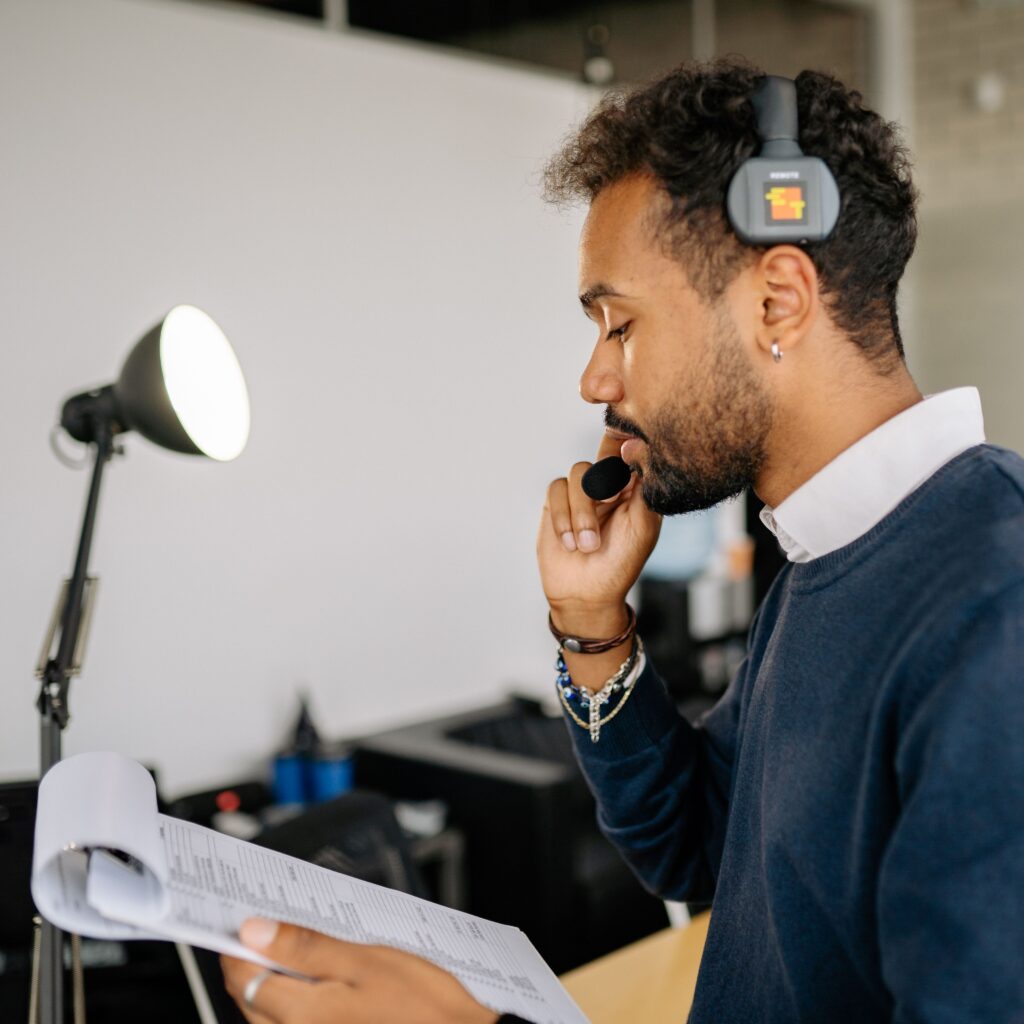
In this process, the interpreter listens to the statement in the source language and conveys its content as accurately as possible into the target language. Depending on the situation, this can be done in person, with a delay, over the phone, or via video conference.
Professional interpreters are used, for example, in the following situations:
- Appointments with Government Agencies
- Discussions with doctors and hospitals
- Legal Proceedings
- Discussions with attorneys
- Appointments at Counseling Centers
- Meetings at Companies
- international business meetings
- Schools and social service organizations
- Phone calls and video conferences
The point is not to translate individual words mechanically. What matters is to To accurately convey the meaning of a statement in its specific context.
Consecutive Interpreting
At the Consecutive Interpreting The participants usually speak in turns. After one person has spoken, the interpreter conveys the statement in the other language.
This type of interpreting is often used in face-to-face conversations, such as at government offices, doctors' offices, counseling centers, or business meetings.
The advantage is that no special technical equipment is required, and any questions regarding linguistic ambiguities can be clarified immediately.
Simultaneous Interpretation
At the Simultaneous Interpretation The language translation occurs almost simultaneously with the spoken original.
This form is used in particular at conferences, events, and certain official or legal situations.
It places high demands on concentration, language skills, and subject matter expertise, as interpreters must listen, process the content, and convey it in the other language all at the same time.
Telephone and Video Interpreting
Nowadays, a professional interpreter does not always have to be physically present at the same location.
At the Telephone Interpreting the language interpreter will be connected via phone. During the Video Interpreting Communication takes place via a video platform.
These forms are also known as Online Interpreting or Remote Interpreting and can be particularly useful for last-minute appointments or when participants are geographically distant.
Digital language mediation thus enables fast, location-independent communication without the interpreter having to travel to the site first.
What does a translator do?
While interpreters work primarily with spoken communication, translators convey written texts and documents into another language.
Typical documents include, for example:
- Birth certificates
- Marriage certificates
- School certificates
- College Transcripts and Diplomas
- Employment references
- medical reports
- Contracts
- Authority documents
- Application documents
- Certificates
- Court documents
A professional translation involves more than just substituting individual words.
The translator must understand the original content and convey it accurately in the target language—both linguistically and in terms of subject matter and content. This is why specialized knowledge is particularly important when dealing with medical, legal, or official documents.
What is the main difference between an interpreter and a translator?
You can remember the difference with this simple rule:
Interpreter = spoken communication
Translator = Written Communication
For example, if you need to speak with a representative at a government agency and do not have a sufficient command of the German language, you will need a Interpreter.
If, on the other hand, you need to submit a foreign birth certificate in German, you will need a Translator.
In some procedures, both services are even required.
Here’s an example: A person has an appointment with a German government agency. An interpreter is needed for the in-person meeting. At the same time, the agency requires a foreign certificate in German. A translation is also needed for this document.
When do I need an interpreter?
An interpreter is particularly useful when important information is discussed verbally and one of the people involved does not understand the other language well enough.
Typical examples include:
Appointments with government agencies:
When applications, personal circumstances, documents, or other important matters are discussed.
Discussions with Doctors and Hospitals:
When you need to understand symptoms, diagnoses, treatment options, or medical instructions.
Court or legal proceedings:
When statements and legally relevant information must be translated accurately.
Business meetings:
When companies communicate with international customers, partners, or employees.
Counseling and Social Services Appointments:
When clear communication is necessary for the consultation.
When do I need a translator?
You'll need a translator if a written document in another language exists and whose content is to be translated into another language.
This is particularly common with documents submitted to German government agencies, universities, employers, or other institutions.
Examples include:
- Certificates
- Transcripts
- Diplomas
- Certificates
- Contracts
- medical documents
- official correspondence
In official proceedings, one should also Before placing an order, it is important to verify what type of translation the recipient requires..
This helps prevent documents from being translated unnecessarily or in a format that will not be accepted later on.
What is a certified translation?
For certain official documents, a simple translation may not be sufficient.
Government agencies, courts, universities, or other institutions may require a translation, the The accuracy and completeness of the translation are certified by a duly authorized translator.
In everyday language, the term certified translation used.
Whether such a translation is actually required depends on the specific procedure and the requirements of the relevant agency.
StartDE Tip: If possible, check with the relevant authority or institution before having your documents translated to determine what requirements apply to them.
Can AI replace an interpreter or translator?
AI-powered translation, Live Translation, automatic speech recognition and real-time translation have advanced significantly in recent years.
Such technologies can be very helpful in simple everyday situations. For example, if you want to understand a menu while traveling or translate a short sentence, you don't necessarily need a professional language service.
The situation is different when it comes to complex situations.
Whether it’s a medical consultation, an appointment with a government agency, a legal matter, or an important business meeting, context, technical terms, dialects, and subtle linguistic differences can make all the difference.
Professional interpreters can do more than just convey words; they can take the linguistic context into account and respond when something is unclear.
That is why AI Translation and Professional Language Mediation Serve Different Purposes. Automatic translation is a helpful tool, but it cannot replace the work of a qualified person in every situation.
Interpreter or translator—which service do I need?
If you're not sure, you can use this simple guideline:
Do you have an appointment or a meeting?
→ You'll probably need a Interpreter.
Do you have a document or a written text?
→ You'll probably need a Translator.
Do you have an appointment and need to submit additional documents?
→ You may need both services.
For official events, any additional requirements—such as those regarding the interpreter’s qualifications or the format of a translation—should always be verified in advance.
Professional Language Mediation and Translation Services with StartDE Consulting
StartDE Consulting supports individuals, companies, government agencies, and institutions with a variety of language-related needs.
Depending on your request, the following services, among others, can be arranged:
- On-site interpreting
- Telephone interpreting
- Online and video interpreting
- Medical Interpretation
- Language Interpretation for Appointments with Government Agencies
- Document Translations
If you're not sure which service you need, you can provide us with the key details about your appointment or document. We can then determine which solution best fits your request.
Let us know the language, date, or document—we'll review your request and find the right language service for you.
Frequently Asked Questions About Interpreters and Translators
What is the difference between an interpreter and a translator?
An interpreter primarily conveys spoken communication between different languages. A translator, on the other hand, works mainly with written texts and documents.
Do I need an interpreter or translator for my appointment with the authorities?
If you have an in-person appointment with a government agency, you will generally need an interpreter. If you also need to submit documents in a foreign language, a professional translation may be required. You should check with the relevant agency to determine the specific requirements.
When do I need a certified translation?
A certified or authenticated translation may be required for certain official documents. Whether it is required depends on the government agency, institution, and the specific procedure.
Can an interpreter also work online or over the phone?
Yes. In addition to traditional in-person interpreting, many conversations can also be interpreted over the phone or via video. Whether this format is permitted or appropriate for a specific official appointment should be confirmed in advance with the relevant agency.
Can Google Translate or AI replace a professional interpreter?
Automatic translation systems can be very useful for simple everyday situations. However, in complex medical, government, legal, or business conversations, context, technical terminology, and accuracy are particularly important. That is why professional human interpretation is often the safer option in such situations.